

In industrial machinery, the reliability of a complete assembly is often determined by the accuracy and stability of its connecting components. Body housings and fitting joints may appear relatively simple compared with motors, pumps, valves, or control systems, but they provide the structural interfaces that allow different components to operate together under mechanical loads, vibration, pressure, and changing temperatures.
For equipment manufacturers and industrial procurement teams, sourcing these components is therefore not simply a matter of finding a metal part with the correct external dimensions. Material selection, dimensional accuracy, machining quality, surface condition, assembly compatibility, and repeatability between production batches all influence the final performance of the equipment.
KUANGDA focuses on metal casting and precision component manufacturing, providing body housings and fitting joints for industrial applications where component accuracy and stable production are important considerations.
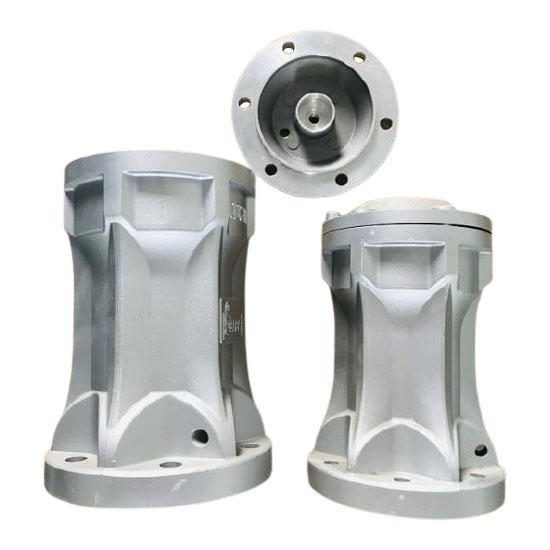
A body housing provides a structural foundation or protective interface for internal components, while fitting joints connect or position different parts of an assembly. If the mating surfaces, mounting holes, threads, or locating features deviate from the required dimensions, installation can become difficult and the finished assembly may experience alignment problems.
Even a relatively small dimensional deviation can become significant when several components are assembled together. This is why dimensional control needs to be considered throughout the manufacturing process rather than only during final inspection.
Industrial equipment can experience continuous vibration, impact, torque, and cyclic loading. Housing and joint components need to maintain their structural integrity under the loads expected in their specific application.
For this reason, buyers should consider material strength, wall thickness, joint geometry, machining accuracy, and surface condition together rather than evaluating a component based only on its appearance or weight.
| Parameter | What Buyers Should Confirm | Why It Matters |
|---|---|---|
| Component Type | Body housing, fitting joint or integrated assembly | Defines the intended mechanical function |
| Material | Aluminum alloy, steel, iron or specified casting alloy | Determines strength, weight and corrosion characteristics |
| Manufacturing Process | Die casting, gravity casting, sand casting, machining or combination | Affects geometry, surface finish and production efficiency |
| Dimensional Tolerance | Critical dimensions and allowable deviation | Supports assembly compatibility |
| Machined Features | Threads, holes, bores, sealing surfaces and locating areas | Ensures accurate connection with mating components |
| Surface Finish | As-cast, machined, polished or coated surface | Influences appearance, sealing and corrosion protection |
| Leakage Requirements | Pressure or sealing requirements where applicable | Important for fluid-handling assemblies |
| Mechanical Properties | Tensile strength, hardness and other application-specific requirements | Helps verify suitability for operating loads |
| Inspection | Dimensional, visual and material inspection | Improves batch consistency |
| Customization | Drawing, sample or 3D model based production | Allows integration with customer-specific equipment |
For equipment where weight reduction is important, aluminum alloys can provide a useful combination of relatively low density and mechanical performance. For applications requiring greater structural strength or wear resistance, iron or steel-based materials may be more appropriate.
The correct choice depends on the actual load, temperature, corrosion exposure, machining requirements, and expected service life. Buyers should therefore provide the supplier with application information rather than specifying material solely according to cost.
Housing and joint components used in outdoor equipment, humid environments, chemical-processing facilities, or other demanding conditions may require additional corrosion protection.
Possible approaches include selecting a more suitable base material, applying surface treatment, or incorporating protective coatings. The appropriate solution should be determined according to the actual environment and the expected service period.
Many industrial housings have irregular external profiles, ribs, cavities, mounting bosses, or integrated connection structures. Casting can produce these shapes efficiently while reducing the amount of material that would otherwise need to be removed through machining.
However, cast components often still require secondary machining for critical interfaces. This is where the combination of casting and precision machining becomes valuable.
Threads, bores, mounting holes, sealing surfaces, and locating features may require tighter dimensional control than general cast surfaces. Machining these areas after casting allows manufacturers to achieve the required fit with mating components.
For buyers, it is useful to distinguish between general casting tolerances and the tolerances of machined functional surfaces. This distinction helps prevent misunderstandings during drawing review and quotation.
Body housings and fitting joints can serve as structural interfaces in mechanical equipment where components need to be securely positioned and connected. Their performance can influence assembly accuracy, vibration behavior, and long-term mechanical stability.
Where fitting joints form part of a fluid-handling system, dimensional accuracy and sealing surfaces become particularly important. Thread quality, mating geometry, and surface condition can directly influence connection reliability.
Automation equipment often contains multiple compact mechanical assemblies working repeatedly at relatively high cycle rates. Housing and joint components therefore need consistent dimensions so that assembly tolerances remain controlled across production batches.
OEM equipment manufacturers frequently require components that are not available as standard catalog parts. In these cases, drawing-based or sample-based manufacturing can provide a more practical route than adapting an unsuitable standard component.
Material consistency is the starting point for reliable casting and machining. Buyers should confirm the required material grade and whether material certificates or composition verification are needed for the project.
Critical dimensions should be inspected using appropriate measuring equipment. Depending on the component, this can include coordinate measuring machines, gauges, calipers, micrometers, thread gauges, and other inspection tools.
For repeat orders, maintaining inspection records for critical dimensions can also help manufacturers identify process drift before it affects larger quantities.
Castings should be checked for visible defects that could affect assembly or service performance. Depending on the application, additional non-destructive testing may also be considered when internal defects could create a significant reliability risk.
For custom body housings and fitting joints, the quality of the initial technical information can significantly affect quotation accuracy. Buyers should provide engineering drawings, 3D models where available, material requirements, annual or batch quantity, tolerance requirements, surface treatment specifications, and intended application.
It is also useful to identify critical dimensions separately from non-critical cosmetic dimensions. This allows the manufacturer to focus process controls and inspection resources where they have the greatest influence on final assembly performance.
For new projects, sample approval or first-article inspection can provide an additional checkpoint before mass production begins.
KUANGDA provides metal component manufacturing solutions for customers requiring customized housings, joints, and other industrial casting and machining parts. For OEM buyers, the ability to work from drawings or application requirements is particularly important because housing and fitting components are normally designed around the customer's complete equipment architecture.
Rather than treating a housing or joint as an isolated metal component, the manufacturing process should consider its relationship with mating parts, assembly sequence, load conditions, machining requirements, and final application.
Industrial buyers are increasingly evaluating suppliers according to more than unit price. Dimensional consistency, production repeatability, material traceability, machining capability, inspection procedures, and communication during engineering development can all influence the actual cost of a component over its service life.
For this reason, Body Housing and Fitting Joints should be evaluated as functional parts of a larger mechanical system. Correct material selection, controlled casting, precision machining, accurate interfaces, and application-specific inspection can help reduce assembly problems and improve long-term equipment reliability.
With a focus on customized metal component manufacturing, KUANGDA provides an option for OEMs, equipment manufacturers, and industrial distributors seeking body housings and fitting joints manufactured according to specific drawings, dimensions, materials, and application requirements.


